

🌍 Where Is Africa on the Map of Green Mobility – And Where Does South Africa Stand?
The global automotive industry is undergoing its biggest transformation in over a century. Electric vehicles (EVs), hybrid systems, battery technology, and renewable-powered mobility are reshaping transportation across the world.
But where does Africa stand in this global shift?
And more specifically — where is South Africa positioned in the green mobility transition?
The Global Context: A Rapidly Changing Industry
Regions such as Europe, China, and the United States have accelerated EV adoption through:
Strong government incentives
Large-scale charging infrastructure
Aggressive emissions regulations
Local EV manufacturing
In some of these markets, electric vehicles already represent a significant share of new car sales. The direction is clear: the future of mobility is electric.
Africa: Emerging, Not Absent
Africa is not leading the EV revolution — but it is not standing still either.
Across the continent, promising developments are taking shape:
Electric buses being deployed in Kenya
National EV strategies emerging in Rwanda
Investment in clean mobility manufacturing in Morocco
Policy discussions and pilot projects in Egypt
Africa’s transition is slower due to:
High EV import costs
Limited charging infrastructure
Grid reliability challenges
Economic constraints
However, Africa also has unique advantages:
Abundant solar energy potential
A young and growing workforce
The ability to “leapfrog” legacy systems and adopt cleaner technology faster
The continent is in its early adoption phase, which presents opportunity rather than disadvantage.
South Africa: The Continental Leader
Within Africa, South Africa is currently the most advanced EV market in Sub-Saharan Africa.
South Africa benefits from:
A well-established automotive manufacturing sector
Global manufacturers such as BMW, Mercedes-Benz, and Toyota operating locally
Expanding charging infrastructure in major cities
Growing policy alignment with international climate commitments
However, EVs still represent a small portion of total vehicle sales. Most electric vehicles currently available in the country fall within the premium segment, limiting mass adoption.
The Real Question: Are We Ready From a Skills Perspective?
While infrastructure and policy often dominate the discussion, one critical factor is frequently overlooked:
Technical skills readiness.
As global markets — particularly the European Union — shift rapidly toward electrified mobility, South Africa’s automotive sector must adapt to remain globally competitive.
This creates an urgent need for:
EV diagnostics specialists
High-voltage system technicians
Hybrid vehicle service professionals
Battery maintenance and safety experts
The transition to green mobility is not just about vehicles — it is about people.
A Defining Moment for Africa’s Automotive Workforce
Africa’s green mobility journey is still in its early stages. That means the technicians, engineers, and automotive professionals who upskill now will become pioneers in this transformation.
For South Africa to maintain its position as a leading automotive hub on the continent, investment in skills development is not optional — it is essential.
The green mobility shift is coming.
The only question is whether we prepare for it — or fall behind.
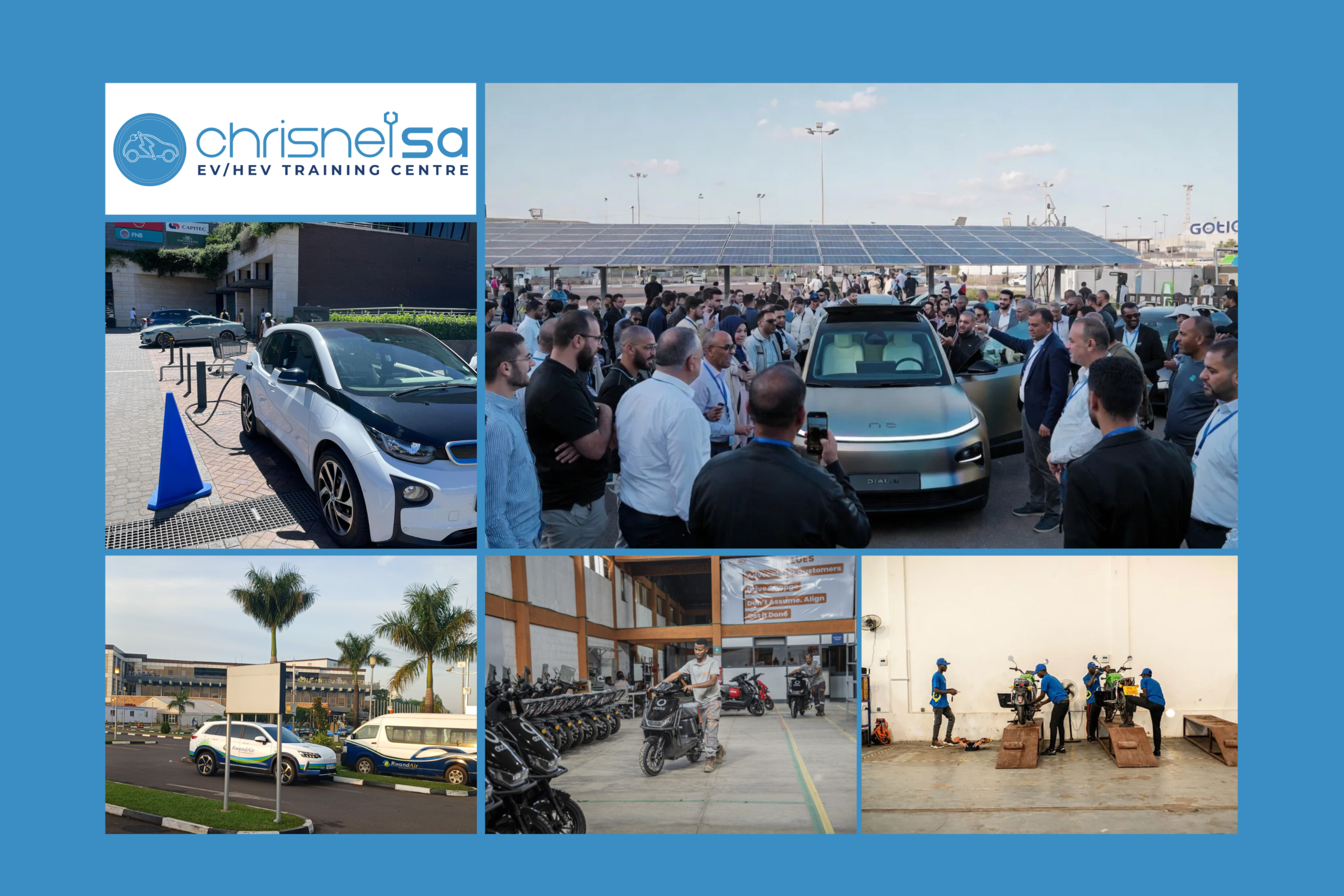
Image Credits & SourcesAmanuel Sileshi / Bloomberg – Electric two-wheelers assembled in Ethiopia.
EV Morocco – Neo Motors Dial-E electric vehicle launch.
Getty Images – Spiro e-bike servicing and battery-swapping operations.
ChrisnelSA – EV vehicle photographed at Kigali International Airport, Rwanda.
PlugShare – EV charging station at Menlyn Maine, Pretoria, Gauteng.

Leave a Reply