

Comparison of the State of EV/HEV Across the Globe, Why South Africa Lags Behind, and How Morocco Has Surpassed It
Published: 28 August 2026
The global automotive industry is undergoing a fundamental transformation.
Electric Vehicles (EVs), Hybrid Electric Vehicles (HEVs), Plug-in Hybrid Electric Vehicles (PHEVs), battery technologies and New Energy Vehicles (NEVs) are rapidly changing how vehicles are manufactured, sold, serviced and maintained.
Countries that recognised this transition early are now building strong EV ecosystems around manufacturing, infrastructure, technology, skills development and investment.
But where does South Africa stand?
The Global EV Transition
China has emerged as the world’s largest EV market and a major force across the entire EV value chain, from battery production and vehicle manufacturing to charging infrastructure.
Europe has continued to push electrification through regulations, incentives and investments in charging networks and clean mobility.
The United States has also invested heavily in EV manufacturing, battery production and technology.
Other emerging economies are increasingly positioning themselves to benefit from the transition.
The important lesson is that successful EV adoption is not only about selling electric cars. It requires an ecosystem.
That ecosystem includes:
- EV and HEV manufacturing
- Battery production and technology
- Charging infrastructure
- Technical training
- Aftersales capability
- Diagnostics and repair
- Local component manufacturing
- Research and development
- Government policy and incentives
- Investment in specialised skills
This is where South Africa faces a significant challenge.
South Africa: A Strong Automotive Industry Facing a New Challenge
South Africa already has one of the most developed automotive industries on the African continent.
We have major vehicle manufacturers, established suppliers, skilled artisans and technicians, and a long history of automotive manufacturing.
However, the transition from Internal Combustion Engine (ICE) vehicles to EVs and HEVs requires a different set of capabilities.
The question is no longer simply:
“Can South Africa manufacture vehicles?”
The question is:
“Can South Africa remain competitive as the technology inside those vehicles changes?”
EV adoption in South Africa has been growing, but the pace remains relatively slow compared with leading international markets.
There are several contributing factors.
1. Vehicle affordability
EVs remain relatively expensive for many South African consumers, particularly when compared with conventional vehicles.
2. Charging infrastructure
The availability and accessibility of charging infrastructure remains an important consideration for consumers and businesses.
3. Policy and investment
Long-term policy certainty is critical if manufacturers, suppliers and investors are expected to commit significant capital to EV production and supporting infrastructure.
4. Skills shortages
Perhaps one of the most underestimated challenges is the availability of technicians and professionals with the specialised knowledge required to safely diagnose, maintain and repair high-voltage EV and HEV systems.
The technology is changing faster than the skills ecosystem supporting it.
Morocco: A Country Moving Aggressively Into the EV Value Chain
Morocco provides an important comparison.
Rather than waiting for EV adoption to become widespread before building its ecosystem, Morocco has been positioning itself as a destination for automotive manufacturing, EV production, battery investment and green mobility.
The country has attracted significant international investment into automotive manufacturing and is developing capabilities across the EV supply chain.
This is important because Morocco is not simply looking at EVs as vehicles that consumers will eventually purchase.
It is looking at the EV transition as an industrial opportunity. That distinction matters.
Morocco’s geographical position, established automotive manufacturing base, investment incentives, trade relationships and industrial strategy have helped it attract manufacturers and suppliers seeking to establish production capacity.
The result is an increasingly competitive automotive ecosystem that is positioning Morocco to benefit from the global transition towards electric mobility.
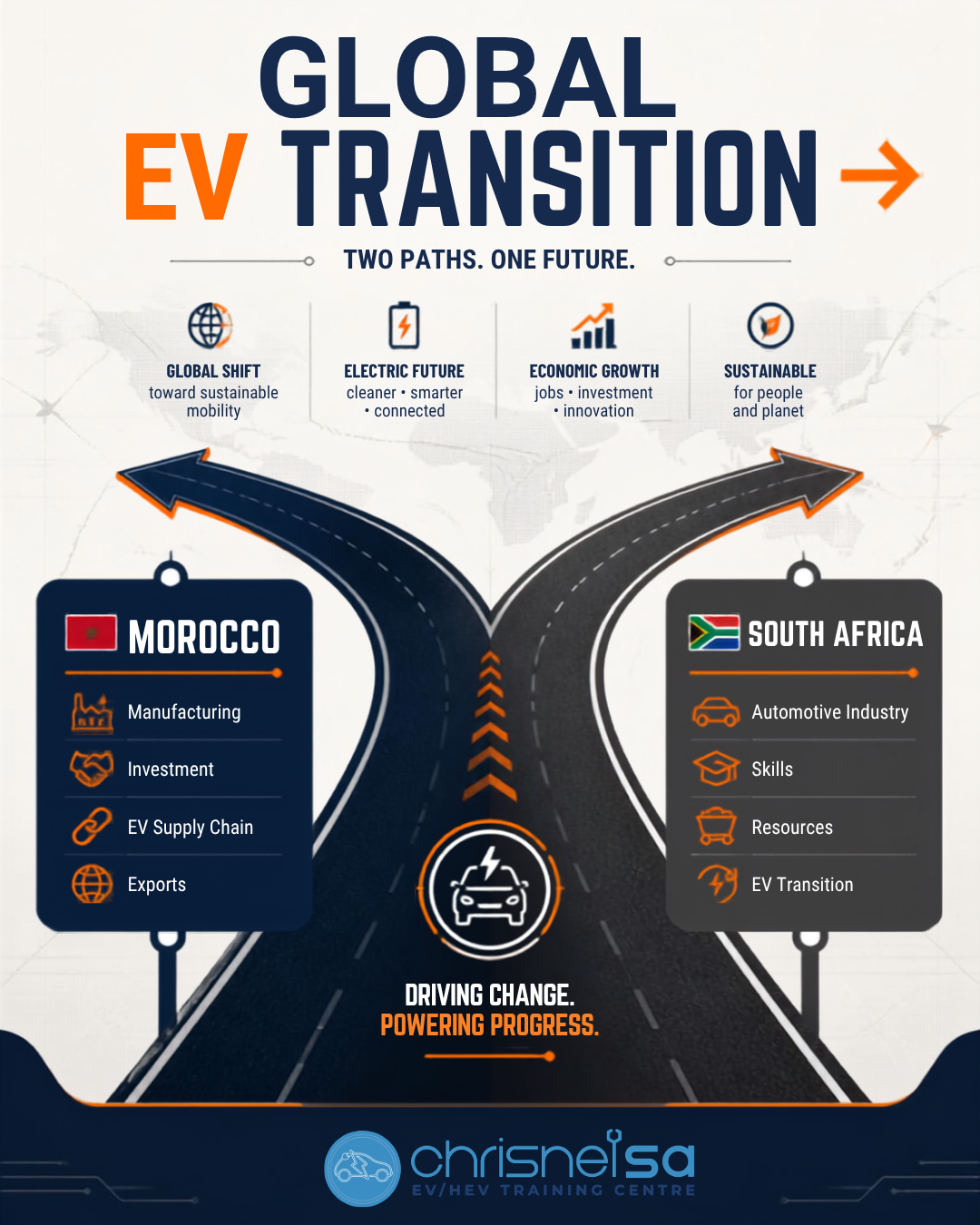
Morocco vs South Africa
The comparison should not simply be about the number of EVs on the road.
The bigger question is:
Which country is building the ecosystem required for the next generation of automotive manufacturing?
Morocco is increasingly positioning itself around:
EV manufacturing → battery investment → supply chains → exports → green industrialisation → skills development.
South Africa has many of the foundations required to compete, but the transition needs to happen faster.
We already have:
- An established automotive manufacturing industry
- Major global OEMs
- Automotive component suppliers
- Technical colleges and universities
- An existing skills development infrastructure
- Significant mineral resources
- An established export industry
These are major advantages.
But advantages only matter when they are converted into action.
The Skills Question
One of the most important elements of the transition is often overlooked:
Who will maintain these vehicles?
As EV and HEV numbers increase, the industry will require technicians who understand:
- High-voltage systems
- Battery technology
- Battery Management Systems
- Electric motors
- Inverters and power electronics
- EV charging systems
- High-voltage safety
- EV diagnostics
- Isolation testing
- Battery health assessment
- Safe repair and maintenance procedures
This creates an enormous opportunity for South Africa.
Instead of viewing the EV transition only as a threat to the existing automotive industry, we should also view it as an opportunity to create new technical careers, new businesses and new areas of specialisation.
South Africa Cannot Afford to Wait
The global automotive industry will not wait for countries to become ready.
Manufacturers will invest where the infrastructure, policy environment, supply chains and skills are available.
Consumers will increasingly have access to EV and hybrid technology.
The question is whether South Africa will have enough trained people and supporting infrastructure to service that market or whether we will increasingly depend on expertise and technology developed elsewhere.
This is why EV/HEV skills development must become part of South Africa’s broader automotive and industrial strategy.
We need to prepare today’s technicians for tomorrow’s vehicles.
We need to prepare TVET students for emerging automotive careers.
We need to support OEMs, dealerships, independent workshops and component manufacturers.
And we need to create opportunities for young South Africans to participate in the new-energy mobility economy.
The Opportunity for South Africa
South Africa still has an opportunity to become a major player in Africa’s EV transition.
But the window of opportunity will not remain open indefinitely.
Our automotive industry has already demonstrated that South Africa can compete globally.
Now we need to demonstrate that we can compete in the New Energy Vehicle era.
That means bringing together:
Government + Industry + OEMs + Training Providers + TVET Colleges + Universities + Investors
to build an ecosystem capable of supporting the vehicles of the future.
At ChrisnelSA, we believe that skills are one of the foundations of this transition.
The EV revolution is not coming.
It is already here.
The real question is:


Leave a Reply